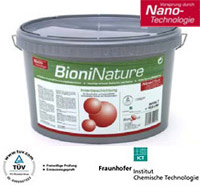
BIONI NATURE®
Multi-functional and environmentally friendly interior paint based upon Nanotechnology
| Benefits: |
| - superior quality and performance |
| - environmentally friendly |
- exceeds indoor air quality regulations
(TÜV Certified) |
- durable protection againts mould and
fungus |
- reduces frequency of repaints and
maintenance |
Product Properties:
- low VOC
- permeable to water vapour
- non-flammable (class A2 according to DIN 4102-1)
- excellent washability (class 2 according to DIN EN 13300)
- superior flow and hiding (class 2 according to DIN EN 13300
- free of solvents
- environmentally friendly
- almost odour free
Recommended Use:
Bioni Nature is suitable for use in rooms where a healthy room climate and indoor air
quality is desired such as living rooms and bedrooms, hotels and restaurants. In addition
it is highly recommended for use in rooms which either already suffer from mould and
moisture, or which seem likely to face these threats, e.g. bathrooms and toilets. Furthermore
Bioni Nature is recommended for use in rooms housing sensitive residents such
as children and people with allergies, e.g. children's rooms, schools and kindergartens
Fundamentals
Mould and Mildew in the Interior of Buildings
Micro organisms such as fungi and bacteria are present in our environment all of the time and are an important, natural
part of it. However if they take the form of mould and mildew growing on walls, they rapidly become a problem.
|
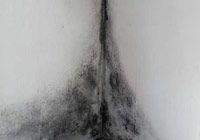
Over the last few years, the problem of mould and mildew inside buildings has become a subject of increasing
importance, for a number of reasons. An increasing incidence of damage caused by mould and mildew inside
buildings has been recorded due to the use of modern building methods; in addition the medical community has
been confronted with an increasing number of people suffering from respiratory diseases as well as allergic
reactions caused by exposure to mould and mildew.
|
|
|
Usually paint containing biocides is used to rectify the damage caused by dampness and mould or mildew. These biocides
remedy the problem in the short term but are by no means a satisfactory overall solution to the problem. The efficacy of
the biocides and fungicides which conventional paints contain quickly tails off and the negative health effects that they
cause have in the meantime been proven beyond doubt.
Principles of Operation
Durable mould protection based on Nanotechnology
 The Bioni Nature coating represents a quantum leap in the field of paints and coatings. Based on the latest knowledge from
the field of nanotechnology, Bioni has for the first time succeeded in developing an inner coating that provides lasting
and high resistance to the formation of mould and mildew without affecting the indoor atmosphere. A compound of substances
based on nano-silver, developed jointly with the Fraunhofer Institute for Chemical Technology, together with the optimum
moisture-regulating qualities of the paint that, with the assistance of silicate lightweight fillers, also affects the
micro-climate on the painted surface to the disadvantage of micro-organisms, hinder over a long period of time the settlement
of micro-organisms thus ensuring preventive resistance to the formation of mould and mildew.
The Bioni Nature coating represents a quantum leap in the field of paints and coatings. Based on the latest knowledge from
the field of nanotechnology, Bioni has for the first time succeeded in developing an inner coating that provides lasting
and high resistance to the formation of mould and mildew without affecting the indoor atmosphere. A compound of substances
based on nano-silver, developed jointly with the Fraunhofer Institute for Chemical Technology, together with the optimum
moisture-regulating qualities of the paint that, with the assistance of silicate lightweight fillers, also affects the
micro-climate on the painted surface to the disadvantage of micro-organisms, hinder over a long period of time the settlement
of micro-organisms thus ensuring preventive resistance to the formation of mould and mildew.
ECO-friendly protection
 An additional characteristic of Bioni Nature is that the paint is completely harmless in terms of the hygiene of the
indoor environment. This fact has been verified by comprehensive tests conducted by the TÜV Product und Environment
Test Institute in Cologne which subsequently awarded the Bioni Nature interior coating the TÜV Rheinland insignia for
wall paints and coatings certified for emissions, but has also received impressive backing as a result of the award of
the “Environmentally Medically Recommended” certificate from the Committee for Environmental Medicine and Building
Hygiene. Bioni Nature also meets the committee’s strict guidelines for the medical assessment of building products (AgBB)
and is also suitable and certified for use in indoor areas in accordance with “Procedures to be used in the Medical
Assessment of Emissions from Occasional Organic Compounds (VOC and SVOC) in Building Products“.
An additional characteristic of Bioni Nature is that the paint is completely harmless in terms of the hygiene of the
indoor environment. This fact has been verified by comprehensive tests conducted by the TÜV Product und Environment
Test Institute in Cologne which subsequently awarded the Bioni Nature interior coating the TÜV Rheinland insignia for
wall paints and coatings certified for emissions, but has also received impressive backing as a result of the award of
the “Environmentally Medically Recommended” certificate from the Committee for Environmental Medicine and Building
Hygiene. Bioni Nature also meets the committee’s strict guidelines for the medical assessment of building products (AgBB)
and is also suitable and certified for use in indoor areas in accordance with “Procedures to be used in the Medical
Assessment of Emissions from Occasional Organic Compounds (VOC and SVOC) in Building Products“.





 Product Flyer (184 KB)
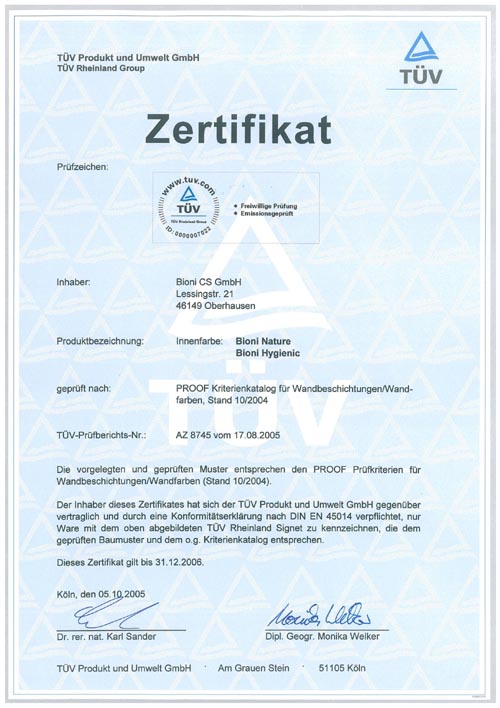 TÜV-Certificate (311 KB)